
What Is Data Governance and Why Does It Matter for Small Businesses?
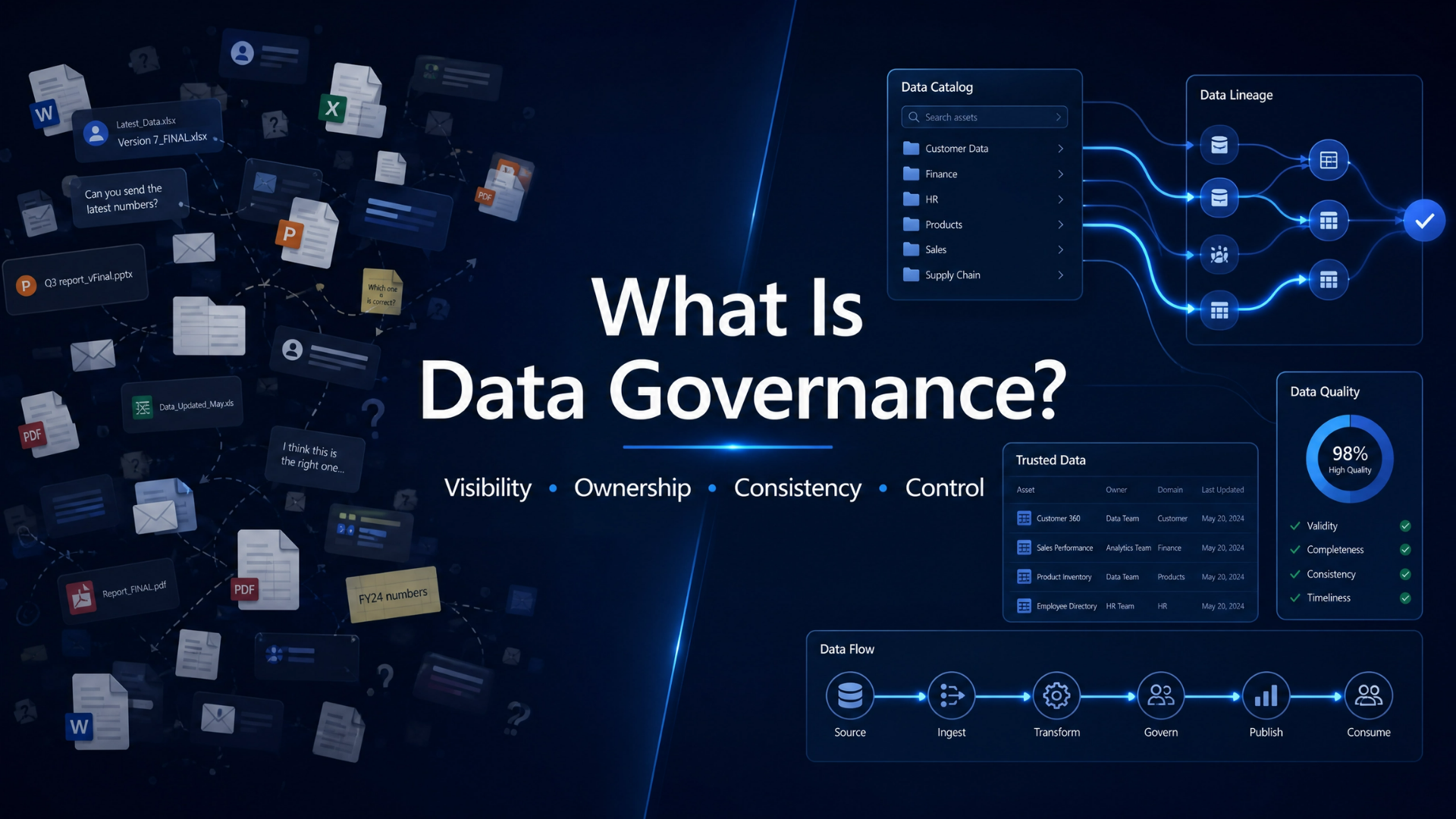
Most small businesses don't think they need data governance.
The term sounds like something reserved for government departments, large enterprises, or highly regulated industries with dedicated compliance teams and complex policies.
But here's the reality:
Every business already has data governance.
The question is whether it's intentional—or accidental.
Every day, your business creates, stores, shares, and relies on information. Customer records, invoices, contracts, employee documents, proposals, emails, spreadsheets, Teams conversations, and reports all play a role in helping your business operate.
Without a clear approach to managing that information, things become harder to find, harder to trust, and harder to protect.
As businesses continue to adopt automation, Microsoft 365, and AI-powered tools like Microsoft Copilot, having strong data governance is becoming less of a luxury and more of a business necessity.
So what is data governance, and why should small businesses care?
What Is Data Governance?
At its simplest, data governance is the framework that determines how information is stored, managed, protected, and used within a business.
It defines:
Who owns information
Where information should be stored
Who can access it
How long it should be kept
How it should be maintained
How it should be used
Think of data governance as the rules and structure that help your business keep information organised, reliable, and secure.
Without governance, information tends to spread across different systems, folders, inboxes, and devices. Over time, this creates confusion, duplication, and inefficiencies that impact day-to-day operations.
Data governance doesn't need to be complicated.
For most small businesses, it starts with creating visibility, ownership, consistency, and control over business information.
The Most Common Misconceptions About Data Governance
Many small businesses delay governance initiatives because they misunderstand what governance actually involves.
Let's address some common myths.
Myth #1: Data Governance Is Only for Large Organisations
This is one of the biggest misconceptions.
Large organisations often have formal governance frameworks, but the underlying challenges exist in businesses of every size.
Whether your business has 10 employees or 1,000 employees, you still need to know:
Where information lives
Who owns it
Which version is correct
Who can access it
In fact, establishing governance early can prevent significant problems as your business grows.
Myth #2: Data Governance Is an IT Problem
Technology plays a role in governance, but governance itself is a business responsibility.
Information is created and used by every department:
Operations
Sales
Finance
Marketing
Human Resources
Leadership
Good governance requires collaboration across the entire organisation.
Myth #3: Data Governance Is Only About Compliance
Compliance is certainly important.
However, governance delivers value beyond regulatory requirements.
Strong governance helps businesses:
Find information faster
Improve productivity
Reduce duplication
Improve decision-making
Strengthen security
Support automation and AI initiatives
Compliance is a benefit of governance.
It shouldn't be the only reason for implementing it.
What Happens When You Don't Have Data Governance?
Many businesses don't realise they have governance issues until the symptoms become impossible to ignore.
Without governance, information becomes harder to manage over time.
Information Becomes Difficult to Find
Employees waste time searching for documents, reports, spreadsheets, and records.
Files may exist, but people don't know where they're stored.
Or worse, multiple versions exist and nobody knows which one is correct.
Duplicate Work Increases
When employees can't find information, they often recreate it.
Documents get rewritten.
Reports get rebuilt.
Spreadsheets get duplicated.
This creates inefficiencies that compound as the business grows.
Decision-Making Slows Down
Good decisions rely on trustworthy information.
When different teams work from different versions of data, confidence in reporting decreases and decision-making becomes more difficult.
Security Risks Increase
Sensitive information may end up stored in locations that aren't properly managed.
Examples include:
Personal folders
Email inboxes
Shared drives
Unmanaged cloud storage platforms
Without clear governance, it's difficult to understand who has access to information and whether that access is appropriate.
AI Produces Poor Results
Many businesses are exploring AI tools, Microsoft Copilot, and automation.
However, AI relies heavily on the quality and accessibility of business information.
If information is poorly managed, AI outputs are likely to be incomplete, inconsistent, or unreliable.
This is why data governance plays a critical role in AI readiness.
Five Signs Your Small Business Has a Data Governance Problem
Not sure whether governance is an issue in your organisation?
These are some of the most common warning signs.
1. Nobody Knows Which Version Is Correct
Multiple versions of important documents exist.
Employees spend time comparing files to determine which version should be used.
2. Information Lives Everywhere
Business information is spread across:
Email
Teams
SharePoint
Shared drives
Personal folders
Cloud applications
People know information exists but struggle to locate it.
3. Employees Spend Too Much Time Searching
If employees regularly ask:
"Does anyone know where that file is?"
governance may be a problem.
Searching for information should not be a daily activity.
4. Ownership Is Unclear
No one knows who is responsible for maintaining critical information.
As a result:
Information becomes outdated
Data quality declines
Accountability disappears
5. Knowledge Leaves With Employees
Important business knowledge is held by individuals rather than documented systems.
When employees leave, information disappears with them.
This creates risk and operational disruption.
The Business Benefits of Data Governance
Strong governance becomes significantly easier when information is stored within a centralised environment rather than being scattered across email inboxes, shared drives, spreadsheets, and personal folders. That's why many organisations begin by centralising business data before expanding automation and AI initiatives.
Data governance isn't about creating more rules.
It's about making information easier to manage.
Better Productivity
Employees spend less time searching and more time working.
Information becomes easier to locate and use.
More Reliable Information
Clear ownership and management processes improve data quality.
Employees gain confidence in business information.
Improved Security
Businesses gain visibility into:
Where information lives
Who can access it
How information is being used
This reduces risk and strengthens security posture.
Easier Compliance
Governance helps businesses meet privacy, security, and regulatory obligations more effectively.
Stronger AI Readiness
Governed data is easier to automate, analyse, and use within AI platforms.
This creates a stronger foundation for future digital transformation initiatives.
Why Data Governance Matters Before AI
One of the biggest mistakes businesses make is treating governance as a separate initiative from AI.
They're closely connected.
AI tools such as Microsoft Copilot rely on business information to generate responses, recommendations, and insights.
If information is:
Disorganised
Duplicated
Outdated
Unmanaged
then AI will struggle to produce meaningful results.
Businesses often assume AI will solve information problems.
In reality, AI tends to expose information problems.
The organisations seeing the greatest value from AI are typically the ones that invested in:
Data visibility
Data governance
Process maturity
Information management
before deploying AI solutions.
This is why governance should be viewed as part of a broader business transformation journey rather than a standalone project.
Where Should Small Businesses Start?
The good news is that governance doesn't require a large team or a major transformation project.
Most businesses can start with a few practical steps.
Step 1: Understand Where Your Data Lives
Before you can govern information, you need visibility into where it exists.
Step 2: Assign Ownership
Every important dataset, repository, or information asset should have a responsible owner.
Ownership drives accountability.
Step 3: Create Structure
Establish clear standards for:
File naming
Folder structures
Storage locations
Information classification
Consistency makes governance easier.
Step 4: Review Permissions
Understand who has access to sensitive information and whether that access remains appropriate.
Step 5: Establish Practical Guidelines
Governance doesn't need to be complex.
Simple policies around creation, storage, sharing, and retention can significantly improve information management.
Data Governance Is the Foundation of Digital Maturity
Many businesses focus their attention on:
New technology
Automation tools
Artificial intelligence
Productivity platforms
These initiatives can deliver significant value.
But they rely on a foundation of well-managed information.
Before businesses can automate workflows, deploy Microsoft Copilot, or leverage AI effectively, they need information that is:
Easy to find
Easy to trust
Easy to manage
Easy to protect
That's exactly what data governance helps achieve.
As organisations mature, governance becomes the bridge between data visibility and business transformation.
It supports the natural progression:
Data → Process → Automation → AI
The stronger the foundation, the greater the value each stage can deliver.
Final Thoughts
Most small businesses don't need complicated governance frameworks or enterprise-level programs.
What they need is visibility, ownership, consistency, and control.
They need confidence that employees can find information when they need it, trust the information they're using, and protect sensitive data appropriately.
Because data governance isn't about creating bureaucracy.
It's about making information easier to find, easier to manage, and easier to trust.
And in a world increasingly shaped by automation and AI, that's a foundation every business needs.