
Why Your Business Isn't Ready for AI Yet — And What to Fix First
Artificial Intelligence is everywhere.
Businesses are experimenting with ChatGPT, investing in Microsoft Copilot, and exploring automation tools at a record pace. Every day, business leaders are being told that AI will transform productivity, improve decision-making, and create competitive advantages.
And they're right.
But many organisations are discovering something unexpected.
Despite investing in AI tools, they're not seeing the results they anticipated.
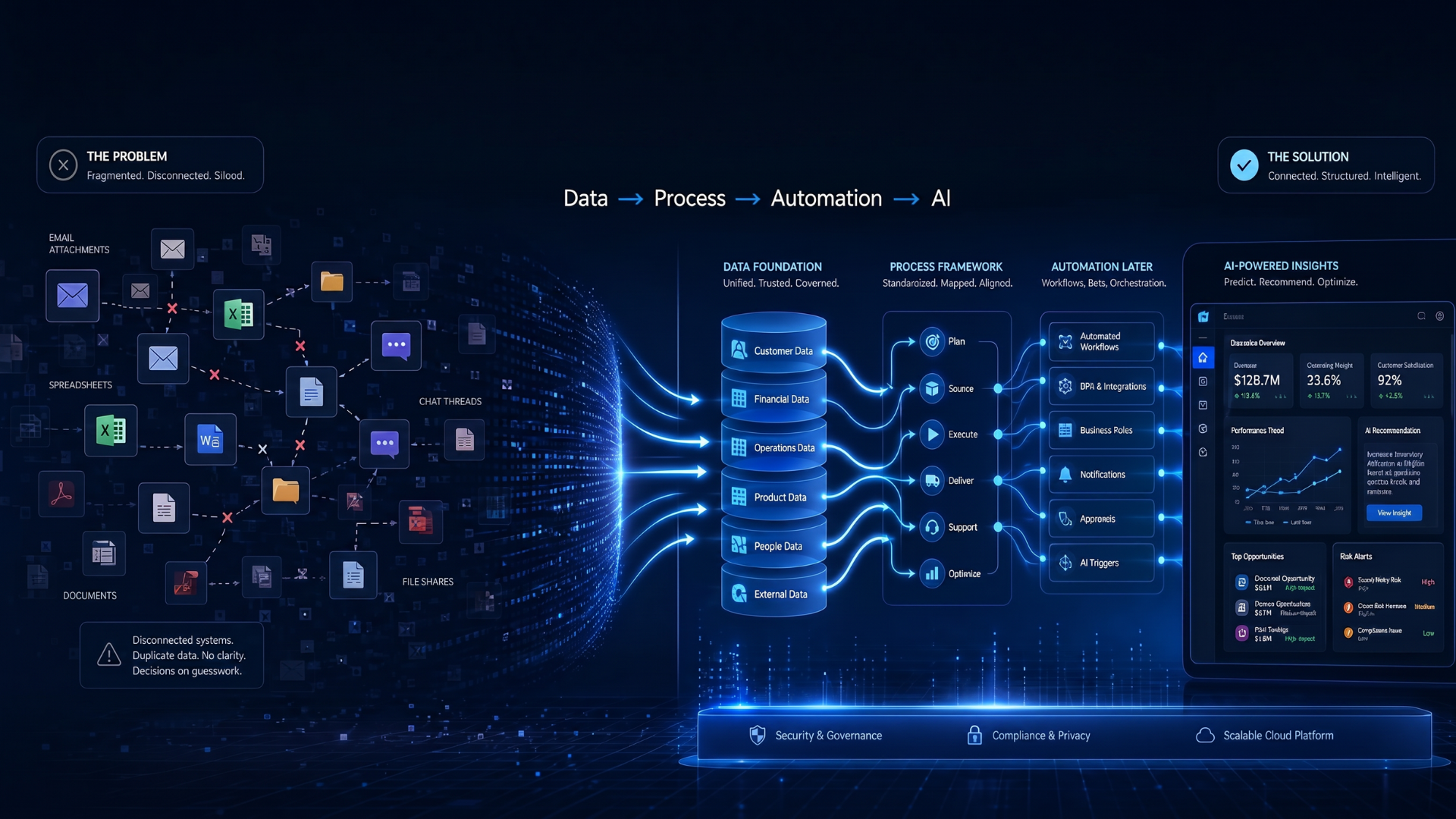
The technology isn't necessarily failing. The problem is that most businesses are trying to build AI on top of disorganised data, inconsistent processes, and fragmented systems.
In other words, they're starting in the wrong place.
At Ezynode, we believe AI should be viewed as the outcome of good business structure—not the starting point. Before AI can deliver meaningful value, businesses need the right foundations in place: organised information, clear processes, effective governance, and operational consistency. This philosophy aligns with Ezynode's strategic consulting framework of Data → Process → Automation → AI, which positions AI as the final stage of business maturity rather than the first.
If you're considering AI adoption, Microsoft Copilot deployment, or process automation, here are the signs your business may not be AI-ready yet—and what to fix first.
Most Businesses Are Starting Their AI Journey in the Wrong Place
When businesses begin exploring AI, they often focus on tools.
They compare AI platforms, evaluate subscriptions, and discuss which models are most powerful.
Questions often sound like:
Should we deploy Microsoft Copilot?
Should we use ChatGPT Enterprise?
Which AI platform is best?
How quickly can we start using AI?
These are understandable questions, but they're not the first questions businesses should be asking.
The more important questions are:
Do we know where our business information lives?
Can employees easily find the information they need?
Are our processes documented and repeatable?
Do we have governance over our data?
Is our information trustworthy?
Because AI does not create order.
AI amplifies whatever already exists.
If your information is structured, accessible, and reliable, AI becomes a powerful business tool.
If your information is fragmented, outdated, and unmanaged, AI simply exposes those problems faster.
Many organisations discover this shortly after rolling out AI tools. Employees begin asking questions, but the responses are inconsistent because the data behind those responses is inconsistent. Documents exist in multiple versions. Information lives across different platforms. Ownership is unclear.
The AI is functioning exactly as intended.
The environment around it is not.
The Real Problem Isn't AI
One of the biggest misconceptions surrounding AI is that successful adoption is primarily a technology challenge.
In reality, AI readiness is a business readiness challenge.
Technology is only one component.
Successful AI adoption depends on four critical foundations.
Data
AI relies on information.
If information is incomplete, inaccurate, duplicated, or difficult to access, AI outputs will suffer.
Process
AI performs best when organisations understand how work flows through the business.
Undocumented or inconsistent processes create confusion that AI cannot resolve.
Governance
Rules matter.
Ownership, permissions, security, compliance, and information management all influence AI effectiveness.
Adoption
Even with excellent technology and data, employees must understand how to use AI responsibly and effectively.
When organisations struggle with AI implementation, weaknesses usually exist within one or more of these foundations.
The AI itself is rarely the root cause.
Sign #1: Your Data Is Scattered Everywhere
For many businesses, information is spread across multiple locations.
Critical documents and knowledge can often be found in:
Email attachments
Teams conversations
Shared drives
Personal folders
OneDrive accounts
Legacy systems
Multiple spreadsheet versions
At first glance, this may seem manageable.
However, over time it creates significant operational problems.
Employees spend excessive amounts of time searching for information. Duplicate files appear. Teams work from outdated documents. Knowledge becomes trapped within individual inboxes and folders.
When AI is introduced into this environment, it faces the same challenges your employees face.
It cannot reliably generate insights from information that is fragmented and difficult to locate.
Consider a simple scenario.
A team member asks an AI assistant to summarise the latest version of a policy.
The problem?
There are six versions of that policy stored across different locations.
Which version should the AI trust?
Without structure, AI struggles to determine the answer.
Before businesses focus on AI readiness, they should focus on information visibility.
A simple question can reveal significant issues:
Can your team find critical business information within five minutes?
If the answer is no, your first challenge isn't AI.
It's information management.
Sign #2: Nobody Owns the Information
Many businesses have information.
Far fewer businesses have ownership of information.
This distinction is important.
Information ownership answers questions such as:
Who is responsible for this document?
Who reviews it?
How often is it updated?
Who can approve changes?
When does it become obsolete?
Without ownership, information quickly becomes unreliable.
Duplicate content emerges.
Old documents remain accessible.
Critical policies are never updated.
Conflicting information spreads through the organisation.
As a result, employees lose confidence in business information.
When AI accesses ungoverned information, it doesn't know which source should be considered authoritative.
AI may generate responses based on outdated content, incomplete records, or duplicate files.
The result isn't necessarily inaccurate AI.
The result is inaccurate source information.
Strong governance creates trust.
And trust is essential if businesses want employees to rely on AI-generated insights.
Sign #3: Critical Business Processes Are Still Manual
This is one of the most overlooked aspects of AI readiness.
Businesses often focus heavily on data while ignoring operational maturity.
Yet processes are just as important.
Many organisations still rely on manual workflows for activities such as:
Invoice approvals
Employee onboarding
Report generation
Customer onboarding
Document approvals
Compliance tracking
These processes often involve multiple emails, spreadsheets, and informal conversations.
Knowledge exists in people's heads rather than documented workflows.
When this happens, inefficiencies become normal.
AI cannot solve process confusion.
In fact, introducing AI into a poorly designed workflow frequently amplifies the problem.
A useful principle is:
You can't automate confusion.
Before AI is introduced, organisations should understand how work actually happens.
This means:
Mapping business processes
Identifying bottlenecks
Eliminating unnecessary steps
Standardising workflows
Documenting procedures
Businesses that do this create the foundation necessary for successful automation and AI adoption.
This aligns with Ezynode's consulting model, which places Process between Data and Automation. The objective is to optimise how work happens before introducing advanced technologies.
Sign #4: You Don't Know What AI Can Access
Security and governance become increasingly important as organisations adopt AI.
Many leaders assume AI only accesses the information they expect.
The reality is often more complicated.
AI tools operate based on permissions.
If users can access information, AI may be able to surface it as well.
This means existing governance issues become more visible.
Common examples include:
Over-shared SharePoint sites
Broad folder permissions
Unmanaged Teams environments
Legacy files that should have been archived
Outdated content that remains accessible
Without proper governance, AI can increase risk rather than decrease it.
Businesses must understand:
Who has access to what
Which information is sensitive
How data is classified
Where obsolete content exists
AI readiness is not simply a capability discussion.
It's also a governance discussion.
The organisations seeing the greatest success with AI are those that balance innovation with control.
The Four Stages of AI Readiness
Many organisations think AI readiness begins when they purchase an AI solution.
In reality, readiness develops through stages.
Stage 1: Data
The first step is understanding information.
Businesses need visibility into:
Where data lives
Who owns it
How it is managed
How it is secured
Without this foundation, every subsequent stage becomes more difficult.
Stage 2: Process
Once information is organised, businesses need clarity around workflows.
This includes:
Mapping processes
Removing inefficiencies
Defining accountability
Creating consistency
Stage 3: Automation
Only after processes are understood should automation be introduced.
Automation removes repetitive work, improves efficiency, and creates operational consistency.
Examples include:
Automated approvals
Notifications
Data collection
Reporting workflows
Stage 4: AI
AI becomes significantly more valuable when supported by mature data, process, and automation frameworks.
At this stage, organisations can leverage:
Microsoft Copilot
AI assistants
Intelligent search
Predictive insights
Workflow intelligence
The businesses that generate the strongest AI outcomes are rarely the ones that move fastest.
They're the ones that build the right foundations first.
What Businesses Should Fix Before Investing in AI
If you're evaluating AI initiatives, focus on these priorities first.
1. Organise Your Data
Identify where business information exists.
Consolidate duplicate repositories and establish a single source of truth where possible.
2. Establish Information Ownership
Assign responsibility for critical content.
Create governance standards for maintenance, review, and retention.
3. Understand Key Processes
Document essential workflows.
Identify inefficiencies and eliminate unnecessary complexity.
4. Improve Governance
Review permissions, classification frameworks, and security controls.
Ensure information is accessible to the right people—not everyone.
5. Automate Repetitive Work
Before implementing advanced AI solutions, remove manual tasks that consume employee time.
This helps create consistency while improving productivity.
How an AI Readiness Assessment Helps
Many organisations know they have challenges but struggle to identify priorities.
This is where a structured AI readiness assessment becomes valuable.
An effective assessment should evaluate:
Data Readiness
Information quality
Accessibility
Data structure
Ownership
Process Readiness
Workflow maturity
Bottlenecks
Documentation quality
Governance Readiness
Permissions
Security controls
Retention policies
Compliance requirements
Technology Readiness
Microsoft 365 configuration
Collaboration environments
Automation opportunities
AI deployment requirements
The objective is not simply to determine whether AI should be implemented.
The objective is to identify what should be fixed first.
Final Thoughts
Most businesses are not failing at AI.
They're simply trying to introduce AI before building the foundations required to support it.
The biggest barriers to successful AI adoption are rarely technical.
They are usually:
Disorganised information
Fragmented systems
Manual processes
Weak governance
Lack of operational structure
The organisations seeing the greatest value from AI aren't necessarily using more advanced tools.
They're creating stronger foundations.
Before asking which AI solution to deploy, ask a more important question: