
Cybersecurity Awareness vs Training: What's the Difference?
If your employees still click phishing emails after “doing the training,” you’re not alone.
Many businesses invest in cybersecurity initiatives but still experience breaches caused by human error. The problem usually isn’t effort — it’s confusion.
Are cybersecurity awareness and cybersecurity training the same thing? Not even close. Understanding the distinction — and knowing when and how to implement each — can be the difference between a breach-free organization and a costly security incident.
In this guide, we’ll break down:
The real difference between cybersecurity awareness vs training
Why most programs fail to change behavior
How to combine both to reduce risk
Practical steps to implement a program that actually works
Why Many Companies Confuse Awareness and Training
On the surface, awareness and training look similar — both involve educating employees. But the purpose and mechanics are very different.
Awareness builds mindset and culture. It focuses on keeping security top of mind.
Training builds capabilities and skills, enabling employees to act correctly in risky situations.
When organizations treat them as the same, they often fall into one of two traps:
Monthly reminder emails labeled as “training” — employees see them, maybe skim them, then forget.
Once-a-year compliance courses — employees complete them, then months later revert to risky behavior.
Both approaches look productive on paper but fail in practice. The result? Employees may know cybersecurity is important but still make critical mistakes when under pressure.
What Is Cybersecurity Awareness?
Cybersecurity awareness is about shaping daily behavior and building a culture of vigilance. It focuses on the “why” rather than the “how.”
An aware employee doesn’t just attend a training session — they notice suspicious emails, question unexpected attachments, and feel responsible for reporting potential threats.
How Awareness Works
Awareness programs use consistent, lightweight reinforcement to keep security top of mind. Techniques include:
Newsletters or micro-tips: Short, digestible content about new threats or best practices.
Posters or digital signage: Visual reminders placed in workspaces or intranet pages.
Alerts and reminders: Monthly emails or pop-ups that reinforce security habits.
Leadership messaging: Security communications from executives to signal importance.
Example
Consider a company that runs a weekly security tip in their internal newsletter. Each tip explains a different threat scenario and a simple, actionable step employees can take. Over time, employees begin recognizing phishing patterns and report suspicious activity more often — without additional training.
Strengths of Awareness
Builds a security-conscious culture across the organization
Improves vigilance and reporting rates
Reinforces behavior over time rather than once-a-year learning
Encourages shared responsibility for security
Limitations
Awareness alone doesn’t provide practical skills. Employees may understand the concept of phishing, but without practice, they might still click a realistic phishing email under pressure. Awareness alone cannot prevent errors in high-stress or complex scenarios.
What Is Cybersecurity Training?
Training is structured, skills-focused learning designed to enable employees to take correct action. It is the “how” part of cybersecurity.
Unlike awareness, training is measurable. It tests understanding, improves competence, and equips employees with the knowledge to respond to real threats.
How Training Works
Training programs can include:
LMS modules: Self-paced lessons with quizzes
Workshops and live sessions: Interactive learning on phishing, password management, or incident reporting
Simulated attacks: Phishing emails or social engineering exercises to practice response in a safe environment
Policy walkthroughs: Ensuring employees understand and can follow organizational procedures
Example
A company implements quarterly phishing simulations. Employees who fail the simulation receive additional coaching, while those who succeed get recognition. Over time, click rates decrease, and employees develop instinctive behaviors for spotting threats.
Strengths of Training
Builds confidence and competence
Provides measurable results for compliance and reporting
Teaches employees to act correctly in specific scenarios
Reduces the likelihood of human error in practical situations
Limitations
Training is often treated as a one-off event. Knowledge can fade quickly without reinforcement. Employees may complete the session, pass the quiz, and return to old habits if not continuously reminded.
Cybersecurity Awareness vs Training: Side-by-Side
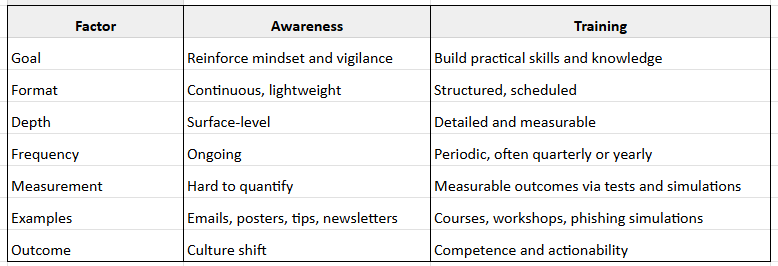
Key Insight: Awareness reminds, training prepares. Both are necessary for effective protection.
Why Awareness Alone Doesn’t Stop Breaches
Human error remains the top cause of data breaches, often due to:
Multitasking under pressure
Misreading emails or documents
Following habitual routines
Lack of immediate guidance
An employee may know phishing exists but still click a realistic invoice email while multitasking. Awareness alerts employees to potential threats, but it cannot teach instinctive correct behavior.
Why Training Alone Doesn’t Ensure Behavior Change
Training is only effective if knowledge is retained and applied. Cognitive psychology shows that people forget most information within days unless reinforced — the “forgetting curve.”
Without ongoing reinforcement:
Skills decay quickly
Employees revert to previous habits
Phishing success rates creep back up
Training without awareness is like teaching someone to swim but never letting them practice in the water — knowledge exists but is not operational.
The Winning Strategy: Combine Awareness + Training
The most successful organizations use a layered approach:
Training to develop skills and knowledge
Awareness to reinforce behaviors and culture
Simulations and feedback to test and improve application
Metrics and reporting to measure impact
This approach ensures employees not only know what to do, but also do it consistently, reducing risk significantly.
Step-by-Step Framework to Build an Effective Program
1. Assess Risk
Identify high-risk processes, departments, and employee behaviors. Use past incident reports, phishing results, and audit logs.
2. Deliver Core Training
Conduct structured courses covering phishing, passwords, device security, and social engineering. Include quizzes and scenario-based exercises.
3. Launch Ongoing Awareness
Send newsletters, tips, alerts, and posters regularly. Integrate with internal comms channels to maintain visibility.
4. Run Simulations
Test employee response using phishing and social engineering exercises. Provide immediate, constructive feedback.
5. Reinforce Continuously
Use micro-learning, reminders, and short videos to embed skills and knowledge into daily routines.
6. Measure Metrics
Track phishing click-through rates, incident reporting, training completion, and behavior improvements.
7. Iterate and Improve
Adjust content, frequency, and focus areas based on results. Security is a continuous process.
When to Use Awareness vs Training
Small teams/startups: Start with awareness, gradually add training as complexity grows
Compliance-heavy industries: Training first, reinforced with awareness
High-risk or regulated environments: Both simultaneously
Remote or distributed teams: Increase simulations and reinforcement
Rule of thumb: If mistakes have serious consequences, don’t rely on awareness alone.
Signs Your Current Program Isn’t Working
Repeated phishing failures
Employees ignore security reminders
No incident reporting
Training happens only once a year
Security feels like “IT’s problem” instead of everyone’s responsibility
These indicate a gap in skills, reinforcement, or culture, which a combined program can address.
Security Isn’t a Lesson — It’s a Habit
Cyber threats don’t wait for annual training. Security awareness and training must be continuous, integrated, and measurable.
Awareness keeps employees vigilant
Training gives them the skills to act correctly
Together, they reduce incidents and strengthen organizational resilience
Think of cybersecurity like fitness:
You don’t get strong from one workout. You get strong from consistent practice.
By embedding awareness and training into daily routines, organizations can transform employees from their biggest risk into their strongest defense.
Frequently Asked Questions about Cyberseurity Awareness vs Training
-
No. Awareness and training solve different problems. Awareness keeps security risks visible through reminders, communications, and culture-building so employees stay alert to suspicious activity. Training teaches specific skills, such as identifying phishing emails, using secure passwords, or reporting incidents correctly. Awareness influences mindset, while training builds capability. Without training, employees lack practical skills. Without awareness, they forget what they learned. Both are required for consistent, real-world protection.
-
At minimum, employees should complete formal cybersecurity training once a year, but that alone is rarely effective. Skills and knowledge fade quickly without reinforcement. A better approach is annual core training supported by quarterly refreshers, phishing simulations, and short monthly micro-lessons. This spreads learning across the year and improves retention. Frequent touchpoints help employees stay prepared for evolving threats instead of relying on outdated knowledge.
-
Yes. Phishing simulations are effective because they test behavior, not just knowledge. Employees experience realistic attack scenarios and learn how to respond in the moment, which builds stronger habits than classroom instruction alone. Regular simulations also provide measurable data, such as click rates and reporting rates, so organizations can track improvement. Companies that run ongoing simulations typically see fewer successful phishing attacks and faster detection of suspicious emails.
-
A security awareness program is an ongoing set of activities that keeps cybersecurity visible in everyday work. It includes regular reminders, short educational content, alerts about new threats, and simple best-practice guidance. The goal is to reinforce safe habits and encourage employees to pause and think before acting. Unlike formal training, awareness is continuous and lightweight, helping maintain attention and reducing careless mistakes over time.
-
Neither is sufficient on its own. Training teaches employees what to do in specific situations, while awareness reinforces those behaviors daily and prevents complacency. Training without awareness leads to forgotten skills. Awareness without training leaves employees unprepared for real threats. Organizations that combine both approaches consistently see better outcomes, including fewer phishing clicks, faster reporting, and lower human-error incidents.